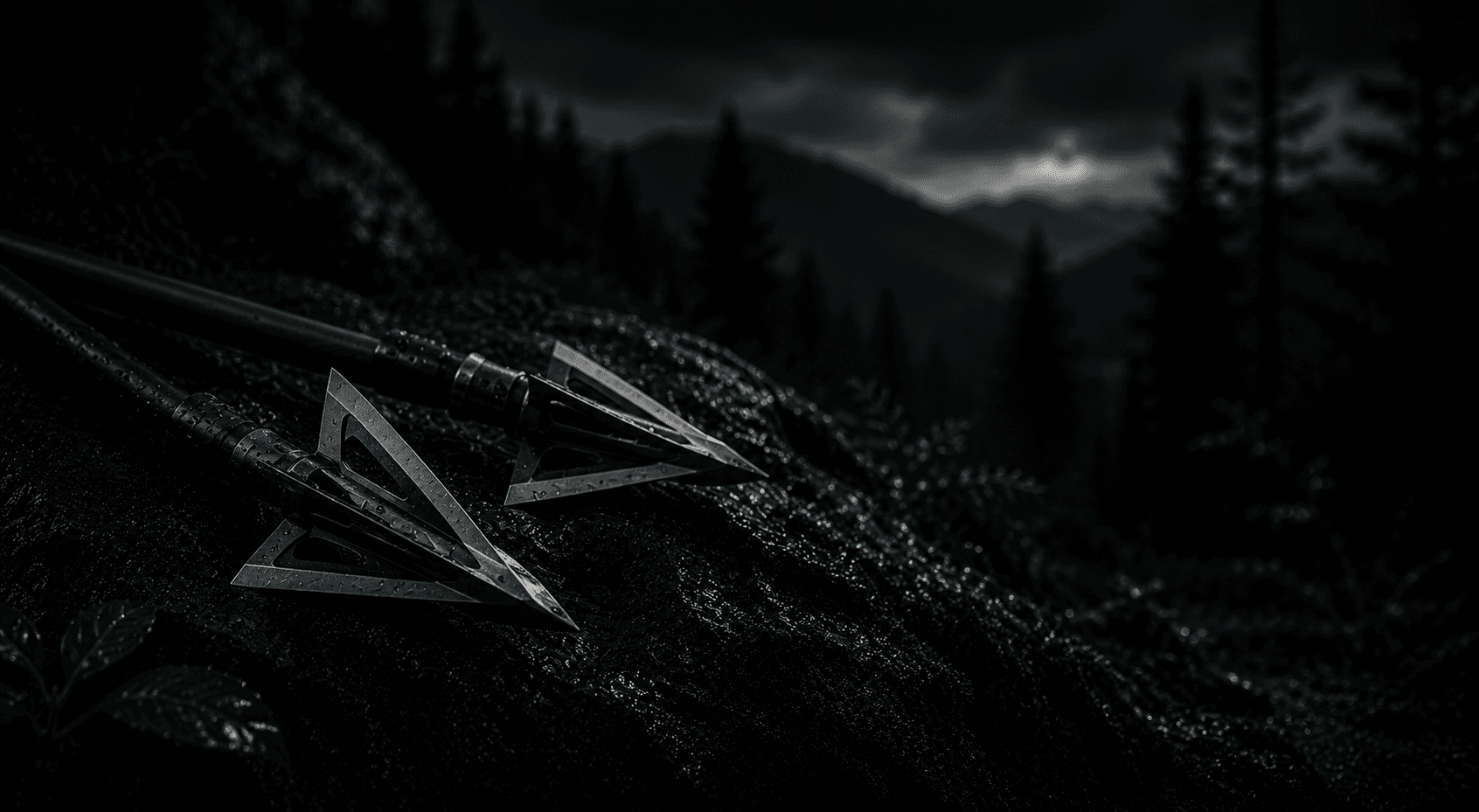
Broadheads that won't group with your field points is one of the most common frustrations in crossbow hunting, and also one of the most fixable — if you check things in the right order. Jumping straight to re-tuning a rest or swapping broadheads before isolating the actual cause wastes bolts and time.
Work through these in sequence rather than jumping around — each step rules out a cause before you spend time or bolts on the next one.
1. Confirm it's actually the broadhead
Before touching anything, re-shoot a group of field points from the same distance. If field points also aren't grouping, the problem is your crossbow, rest, or scope zero — not the broadhead — and no amount of broadhead tuning will fix it.
2. Spin-test each broadhead
Thread the broadhead onto the bolt and spin it on a fingertip or a broadhead spinner. Visible wobble means a bent blade, a warped ferrule, or an insert that isn't seated straight — replace or re-seat it before shooting it again.
3. Check fletching and vane clearance
A blade or vane clipping the arrow rest, riser, or rail on the way out throws off flight in a way that looks identical to a bad broadhead. Watch (or slow-motion record) a shot from behind to see if anything is making contact during launch.
4. Rule out a speed mismatch
Not every mechanical broadhead is rated for crossbow speeds — some open in flight or fly erratically above their rated FPS ceiling. Check the broadhead's published speed rating against your crossbow's actual FPS before assuming the head itself is defective.
5. Compare fixed vs. mechanical behavior
If a fixed-blade head groups poorly but field points fly true, a mechanical head — which flies closer to a field point in the first place — can isolate whether the issue is blade-surface drag and torque rather than your setup.
Common Causes, Explained
Point-of-impact shift between field points and broadheads
Broadheads catch more air than field points, so some shift in group location is normal and expected — the problem is a large shift or one that changes shot to shot. A small, consistent shift usually just means re-sighting a broadhead-specific pin or zero; an inconsistent one points to a mechanical issue with the head itself.
Fletching or vane clearance
Vanes or blades that clip the rest, riser, or rail on the way out create inconsistent flight that looks exactly like a tuning problem. This is the single most common cause of erratic broadhead flight and the cheapest to rule out — it costs nothing but a careful look.
A bent blade or warped ferrule
Broadheads take real abuse in a quiver or pack, and a barely-visible bend in one blade is enough to cause wobble in flight. The spin test catches this reliably; a broadhead that wobbles when spun by hand will wobble in flight too.
Speed rating mismatch
Mechanical broadheads are engineered around a specific speed range, and pushing one above its rated FPS can cause premature or inconsistent blade deployment. This is a crossbow-specific problem — a mechanical head that performs fine from a compound bow can behave differently at crossbow speeds.
Inconsistent broadhead installation
A broadhead that isn't threaded on straight and snug will fly differently than one that is, even if the head itself is perfect. Always thread by hand until it seats fully, and re-check it after any hard hit or pass-through.
Bolt spine or weight mismatch
A bolt that isn't matched to your crossbow's draw weight and speed can flex inconsistently in flight, a problem that shows up more with heavier broadheads than with a bare field point. If broadheads consistently fly worse than field points across multiple heads, check your bolt spec against your crossbow's manual before blaming the broadheads.
Fixed vs. Mechanical: Which Tunes Easier
Fixed blades are more sensitive to small imperfections
A fixed-blade head like the NAP Thunderhead Broadhead 100 GR 5 Pack or Muzzy Trocar Broadhead 3-Blade 100gr Stainless Steel Pack of 3 catches more air on its exposed blades, so a slightly bent blade or a clearance issue shows up more obviously in flight than it would on a mechanical head.
Mechanical heads fly closer to field points
A mechanical head like the Ravin Steel Broadheads or NAP Killzone 2 Blade 100gr Mechanical Broadhead Silver Black 3pk stays closed in flight, which is why it groups closer to field points and can help isolate whether a flight problem is really about the broadhead or something else in your setup.
Switching styles is a valid diagnostic step
If you've worked through the checklist above and a fixed-blade head still won't group, shooting a mechanical head from the same bolts can tell you whether the issue is blade-specific or something upstream in your setup. See the full fixed-blade vs. mechanical comparison for the full tradeoff.
FAQ
Some shift is normal — broadheads catch more air than field points, so a small, consistent difference in point of impact is expected and usually just needs a broadhead-specific sight pin or zero. A large or inconsistent shift points to a mechanical issue: fletching clearance, a bent blade, or a speed mismatch, not something you can sight your way around.
Re-shoot field points first. If field points also aren't grouping, the problem is your crossbow, rest, or scope zero, not the broadhead, and troubleshooting the broadhead itself will waste time and bolts.
Thread it onto a bolt and spin it on a fingertip or a broadhead spinner. Visible wobble means a bent blade, a warped ferrule, or a misaligned insert — replace or re-seat it rather than shooting it again.
Yes. Mechanical broadheads are engineered around a specific speed range, and running one above its rated FPS can cause premature or inconsistent blade deployment. Always check a mechanical head's published speed rating against your crossbow's actual FPS before assuming the head itself is the problem.
Disclosure: As an Amazon Associate, HuntGearGuide earns from qualifying purchases. Some links above are affiliate links from other partners too, at no extra cost to you. This helps us keep the tools free.