
First-time deer hunter on a budget
Lightweight, complete package, proven performance under $350.
See Barnett Whitetail Hunter II →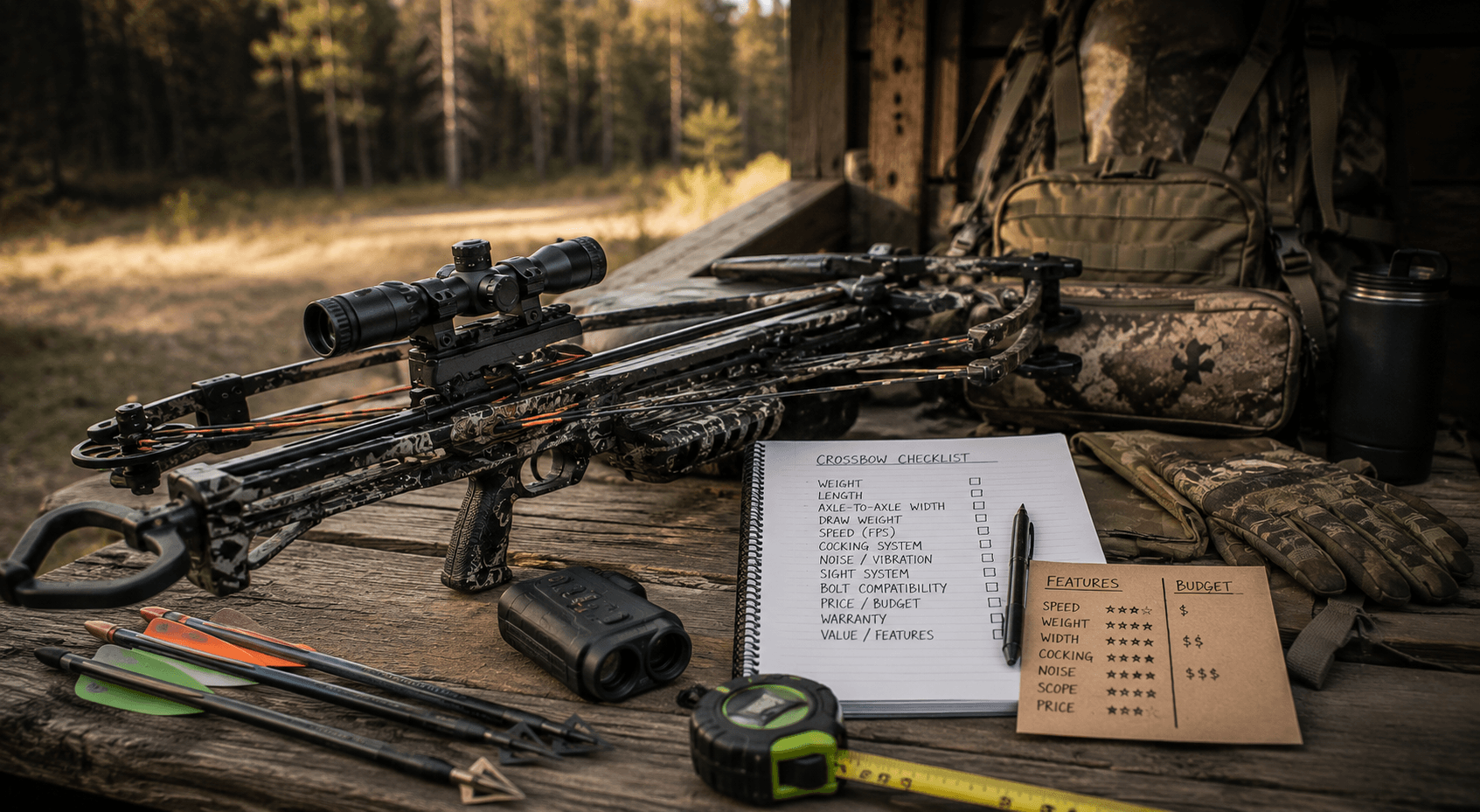
Home / Buying Guides / How to Choose a Crossbow
Filter the noise and focus on the specs that actually matter in the field.
Crossbow spec sheets are full of numbers that sound important but don't always translate to real-world hunting performance. FPS is the most marketed figure, but cocked width, draw weight ergonomics, and overall weight often matter more for how the bow actually feels in a treestand or blind. After hunting with crossbows from both ends of the price spectrum, the specs that consistently matter most in the field are rarely the ones manufacturers lead with.
This guide breaks down each key spec, explains what it actually means for hunting, and tells you when it matters and when it doesn't. By the end you'll have a clear framework to evaluate any crossbow — and a shortcut to our specific recommendations if you already know what you need. For a faster answer, use the Crossbow Selector; for side-by-side specs, open the comparison table.
FPS measures how fast the bolt leaves the crossbow. It affects trajectory flatness, downrange energy, and how forgiving the bow is when you misjudge a distance.
For deer and turkey hunting at typical distances (20–50 yards), anything above 320 FPS is adequate. Most modern crossbows in the $300–$500 range hit 350–430 FPS, which is more than enough for ethical kills on medium game.
Where FPS starts to matter more: long-range shots, elk hunting (where more energy on impact is valuable), and situations where you routinely shoot past 60 yards. At that point, a bow in the 400–450+ FPS range gives you a meaningful advantage.
The trap to avoid: chasing FPS at the expense of everything else. A 430 FPS bow that's heavy, wide, and noisy may perform worse in the field than a 360 FPS bow that's light and easy to handle.
Draw weight is how hard you have to pull to cock the crossbow. Unlike vertical bows, you don't hold the draw weight — the crossbow does. What you feel is the effort required to cock it, which is typically done with a rope crank or mechanical crank system.
Most modern crossbows fall in the 150–200 lb draw weight range. Higher draw weight generally produces more speed, but the cocking experience matters too. A bow with 185 lbs of draw weight and a built-in silent crank (like the CenterPoint Wrath 430X) can be easier to cock than a 150 lb bow with only a rope cocking aid.
If you have limited upper-body strength, look specifically for bows with integrated crank systems rather than just rope aids. Premium bows like the Ravin R10X Pro use a smooth HeliCoil system with only 100 lbs of draw weight while still hitting 400 FPS.
Cocked width is how wide the crossbow is once it's loaded and ready to fire. This is one of the most practically important specs for hunting, and one of the most overlooked by first-time buyers.
Wide crossbows (17"+ cocked) are harder to maneuver in a treestand, more likely to snag a blind when swinging on a bird, and generally less comfortable to carry in thick cover. Narrow crossbows (10–14") feel more like a rifle and fit in tighter shooting windows.
If you hunt from a box blind or ground blind: aim for under 14" cocked width. If you hunt from a treestand: under 12" is noticeably better. If you hunt in open terrain from the ground, width matters less.
Budget crossbows tend to be wider (15–18"). Getting a genuinely narrow bow usually means moving up in price — the Ravin lineup at 10.5" is the benchmark.
Crossbow weight affects how long you can hold it steady at full draw and how tiring it is to carry in the field. It matters more on hunts that involve a lot of walking or holding position for extended periods.
Most hunting crossbows fall in the 6–8 lb range without accessories. Add a scope, bolts, and a quiver and you're looking at 8–10 lbs. That's manageable for most adults, but hunters with physical limitations or those doing serious backcountry miles will want to prioritize lighter builds.
The lightest option in our lineup is the Ballista BAT at 3.5 lbs — purpose-built for mobility. The Barnett Whitetail Hunter II at 6.4 lbs is a good middle ground.
Crossbow pricing has two distinct value tiers. The $300–$500 range has genuinely strong options — reliable, accurate, and fully capable for deer and turkey hunting. The $1,500–$3,000 range is where the premium brands like Ravin live, with meaningfully better width, accuracy systems, and build quality.
The $500–$1,500 range is thinner on standout value. Most hunters end up better served by either committing to a quality budget bow or saving up for a true premium option rather than landing in the middle.
Our recommendation: if your budget is under $500, buy the best bow in that range and put the leftover money toward quality bolts, broadheads, a rangefinder, and practice. If your budget is flexible, define what you actually need — compactness for blinds, elk capability, lifetime value — and price backwards from there.
Crossbows are more forgiving than vertical bows, but there's still a learning curve. For first-time hunters, simplicity is worth more than peak specs.
Look for bows that come in a complete package (scope, bolts, quiver included) so you can start shooting without extra purchases. Avoid bows with complex cocking systems that add steps before every shot. Prioritize lightweight builds that are easy to handle while you're still developing your form.
Once you've put a season or two behind you, you'll have a much better sense of what you actually need — whether that's more compactness, more speed, or a quieter shot. That's the right time to invest in a premium upgrade.
Map your situation to a starting recommendation.
Lightweight, complete package, proven performance under $350.
See Barnett Whitetail Hunter II →Ultra-compact for blind shooting; weight is more useful than FPS at turkey ranges.
See Ballista BAT or Ravin R10X Pro →10.5" width, Helicoil accuracy, and build quality that won't become a limitation.
See Ravin R10X Pro →430 FPS for under $400 with a silent crank — the best budget speed option.
See CenterPoint Wrath 430X →For deer and turkey at normal hunting distances, 350 FPS is plenty. Field handling, width, and weight affect more hunts than raw speed.
A narrow bow in a treestand or blind is a meaningful quality-of-life upgrade. It's worth paying for if you hunt in tight setups regularly.
The $300–$500 range and the $1,500+ range are both strong value tiers. The middle is where value gets murkier. Know which side of that line fits your situation.

For deer and turkey at typical hunting distances (20–50 yards), 320+ FPS is adequate. Most modern crossbows in the $300–$500 range hit 350–430 FPS, which is plenty. FPS matters more for long-range shooting, elk hunting, or shots past 60 yards.
Most hunting crossbows use 150–200 lb draw weight, but you don't hold that weight — the crossbow does. What matters is how the bow is cocked. Look for integrated crank systems if you want an easier experience. Higher draw weight generally means more speed, but cocking convenience matters too.
Under 14" for ground blind hunting, under 12" for treestands. Budget crossbows tend to be wider (15–18"). Narrow crossbows (10–11") are found mainly in the premium tier. If you hunt in open terrain, width matters less.
The best value tiers are $300–$500 (budget, fully capable for deer and turkey) and $1,500–$3,000 (premium, meaningfully better width and accuracy). The $500–$1,500 range is thinner. Most hunters do best by going fully budget or saving up for a premium option rather than splitting the difference.
Yes — crossbows are generally more beginner-friendly than vertical bows because you hold the draw mechanically rather than physically. Look for a complete package with scope and bolts included, a lightweight build, and a simple cocking system.
Use the crossbow selector to get a pick matched to your exact budget, experience level, and primary game — no scrolling required.