
Regulations matter
Crossbow legality varies by state and season, so access is treated as a core buying factor instead of a footnote.
Home / Buying Guides / Crossbow vs Compound Bow
Compare learning curve, season access, and the way each bow fits your hunt.
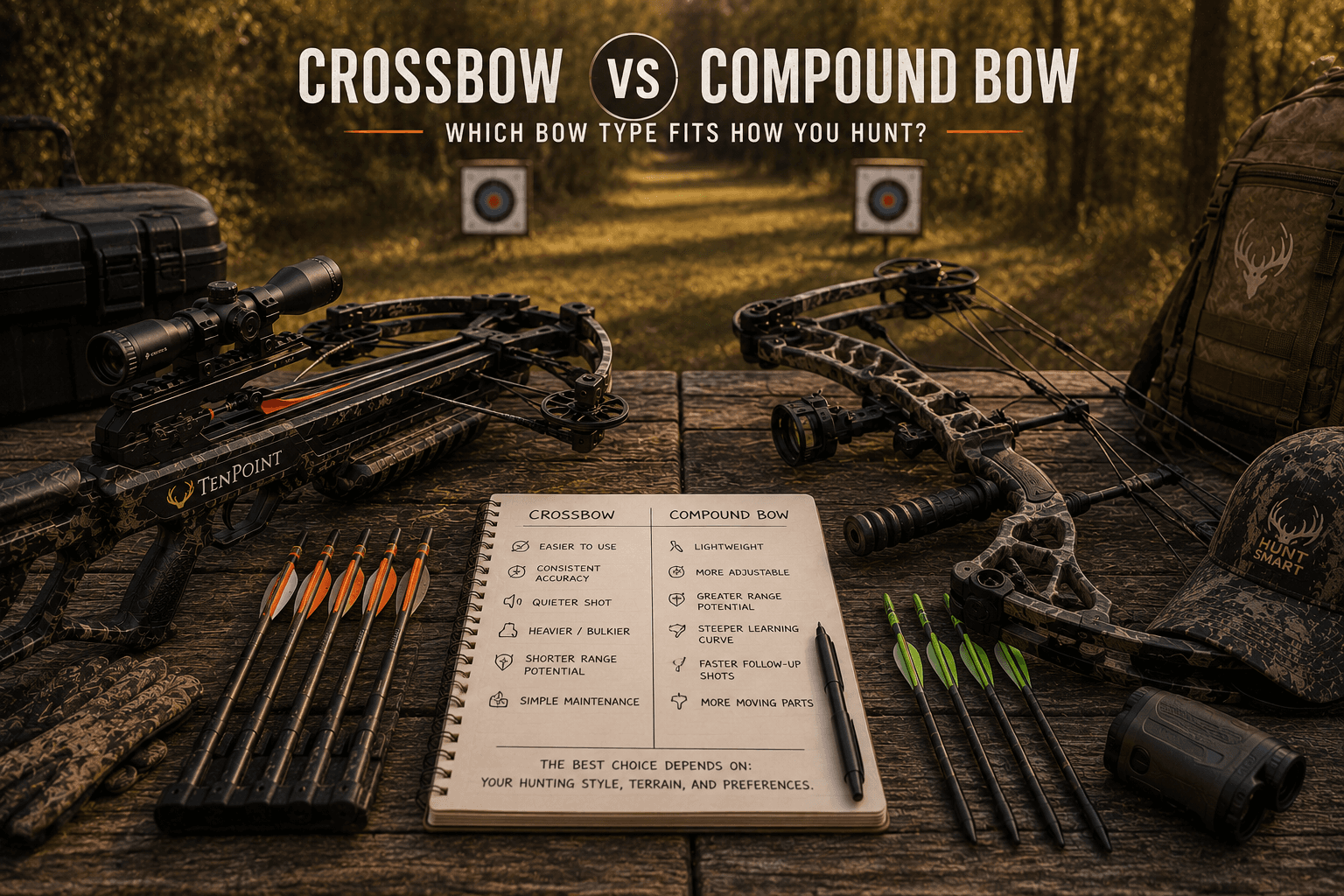
The crossbow vs compound bow debate comes down to two core trade-offs: ease of use vs. archery season access. Crossbows are faster to learn and require less physical demand, but they're restricted from archery season in a number of states. Compound bows take longer to master but are legal in archery season everywhere and are more compact for backcountry hunting.
Neither is universally better. The right choice depends on your state, how you hunt, and how much time you're willing to put into practice before opening day.
This comparison is based on practical hunting trade-offs rather than brand preference: learning curve, legal access, physical demand, packability, and typical use in the field.
Crossbow legality varies by state and season, so access is treated as a core buying factor instead of a footnote.
We compared the amount of practice and physical consistency most hunters need before they can make ethical shots.
Stand hunting, backcountry hunting, injury accommodation, and multi-state hunting all push the recommendation in different directions.
Unless a page explicitly says a product was tested hands-on by HuntGearGuide, recommendations are based on product specifications, owner review data, merchant/manufacturer information, and practical hunting-use fit. Prices, ratings, review counts, and availability are point-in-time snapshots, so confirm the current merchant listing before buying.
A crossbow is the faster path to shooting accurately. It operates more like a rifle than a traditional bow — you cock it, put it in the shoulder, and pull the trigger. Most hunters can shoot a crossbow accurately within a single range session. A compound bow requires developing consistent form, anchor points, and the ability to hold 50–70 lbs of draw weight steady while aiming. That takes weeks or months for most beginners.
This is the most important factor many hunters overlook. If your state restricts crossbows to firearm season — which several states still do — buying a crossbow means giving up the longer archery season window. Check your state's regulations before deciding. If you hunt in multiple states, a compound bow gives you season access everywhere without having to verify crossbow rules each time.
Compound bows are meaningfully lighter and more compact. If you're doing backcountry elk or mule deer hunts with long approaches through dense timber, a crossbow's extra bulk adds up. For most whitetail hunters hunting from stands or blinds within a short walk of a vehicle, the size difference is minor.
Crossbows remove most of the physical demand from the shot. You cock the bow before you're in position — using a crank or rope aid — and then the bow holds that energy until you're ready to shoot. For older hunters, hunters with shoulder or arm injuries, or hunters with disabilities, this is often the deciding factor. Compound bows require you to draw at the moment of the shot, which can be difficult in cold weather, awkward positions, or with an animal in close range.

Yes, for most hunters. A crossbow stays cocked and fires like a rifle — you don't hold draw weight while aiming. A compound bow requires you to draw and hold at full draw (typically 50–70 lbs) while acquiring your target and settling the pin. Crossbows have a significantly shorter learning curve for new hunters.
It depends on your state. Crossbows are legal during archery season in roughly half of U.S. states, including most Southern states and many Midwestern states. In others — like Michigan, Wisconsin, and Ohio — crossbows are restricted to firearm season unless you have a disability permit. Always check your state's current regulations before purchasing a crossbow.
At typical hunting distances (20–50 yards), both are accurate enough to take deer cleanly with practice. The crossbow's advantage is that it's easier to hold steady since you're not fighting draw weight at the moment of the shot. A well-practiced compound bow archer is every bit as accurate, but it takes more time to develop that consistency.
For most hunting situations, yes — especially in states where crossbows are legal during archery season. The main trade-off is losing archery-only season access in states that don't allow crossbows. If you hunt multiple states or plan to hunt archery-only seasons, a compound bow gives you more flexibility.
A crossbow is generally the better starting point. The shorter learning curve means you're shooting accurately much faster, which reduces frustration and builds confidence. That said, if you're committed to traditional archery or hunting states with archery-only restrictions on crossbows, starting on a compound bow makes more sense long term.
Use the crossbow selector to find the right model for your budget, experience level, and target game.